Broadcast Once, Deliver Everywhere: SES as an Operational Bet
ONE Media’s vision is bold: a single ATSC 3.0 broadcast that reaches every screen — TVs, tablets, phones — without a separate streaming workflow. DigiCAP’s Signaling Export Service (SES) is what makes that possible, and we’ve demonstrated it at NAB 2026 with Sinclair.
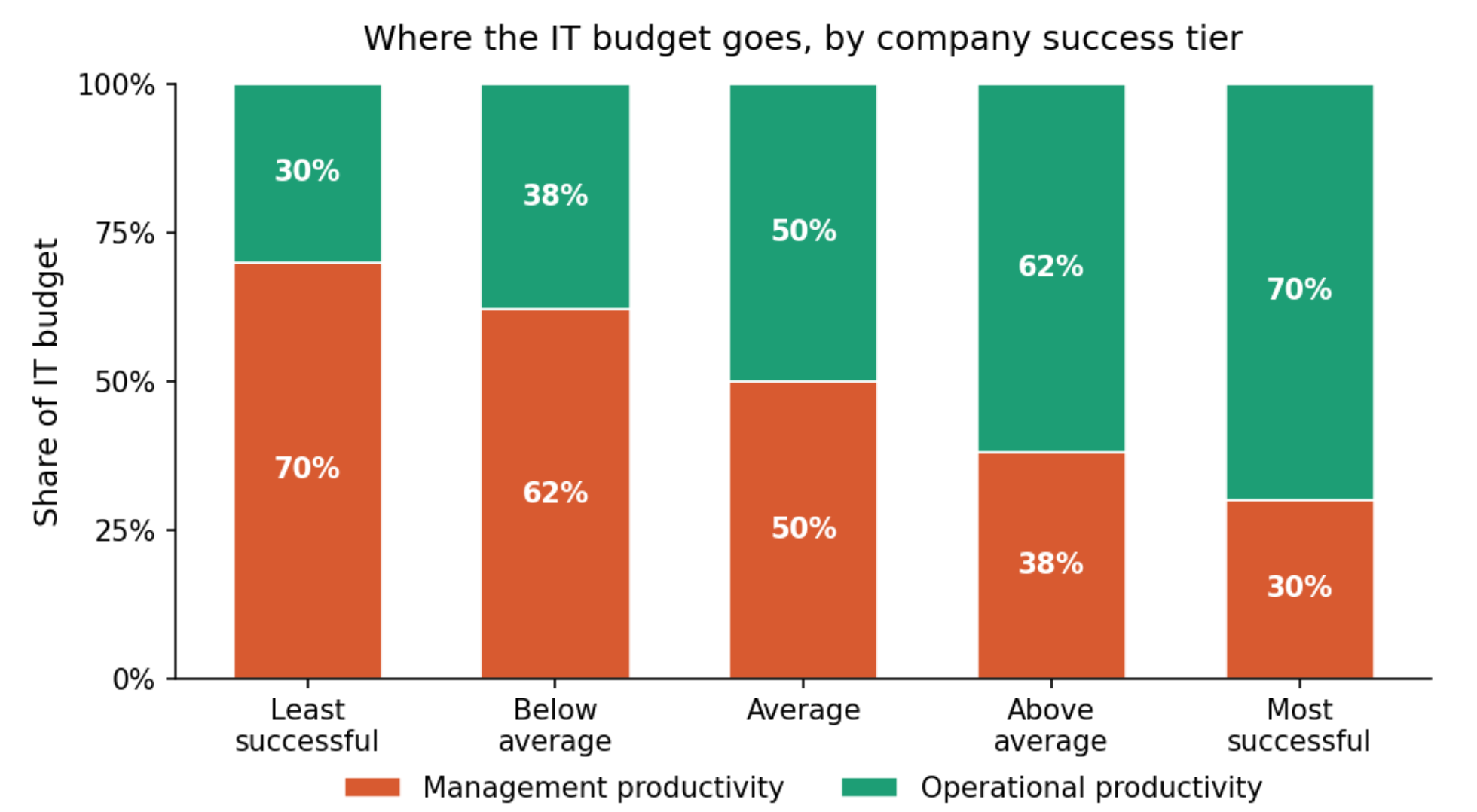
Before I get to what SES does, look at this chart.
It’s from Paul Strassmann’s The Business Value of Computers (1990) — the book Steve Jobs said had stung him personally. Strassmann surveyed hundreds of companies and found that total IT spending didn’t correlate with profitability at all. But the split did. The least successful companies put 70% of their IT budget into management productivity — PCs, spreadsheets, email, the tools that help white-collar staff move paper around faster. The most successful ones inverted it: 70% on operational productivity, the software that runs the actual core of the business.
Jobs’ line on this, from his 1992 MIT Sloan talk:
“You can’t go down to your local computer store and buy an app that will help you do stock trading, or will help you run a hospital, or will help you in whatever operational part of your business you want to automate.”
Operational software has to be custom-built for the shape of the business. That’s why most companies default to management productivity — it’s purchasable. Operational is harder, slower, and where the winners spend.
What this looks like for a broadcaster
For a station group like Sinclair, the operational core is delivery — getting programs from the studio onto a viewer’s screen, reliably, everywhere. Management productivity for a broadcaster is the suite of tools that runs the office. Useful, but not what differentiates the business.
The traditional way to extend broadcast reach to non-tuner devices has been to bolt on a streaming pipeline: a parallel encoder, a separate packager, a second CDN, and two sets of service metadata that quietly drift apart. That’s overhead, not operational transformation.
SES is the operational alternative. It takes the signaling DigiCaster already produces — the same channels, schedules, and service descriptions broadcast over the air — and publishes it to the cloud, continuously, on the same standard (ATSC A/331) any compliant receiver already understands. One signaling source. One service catalog. Two delivery paths. No drift.
Why it counts as operational
SES (Signaling Export Service) isn’t an app you can order off a shelf. It’s custom-built for how a NextGen TV plant actually operates — DigiCaster’s data model, ATSC 3.0’s signaling envelopes, real-world failover between RF and IP. That’s the multi-year, executive-patience work Strassmann was pointing at.
Sinclair’s bet on ATSC 3.0 has always been a bet on broadcasting becoming national IP infrastructure rather than local RF. SES is one of the operational tools that makes that bet payable.